 |
ros2_control - rolling
|
Loading...
Searching...
No Matches
Store gains in a struct to allow easier realtime box usage. More...
#include <pid.hpp>
Public Member Functions | |
| Gains (double p, double i, double d, double u_max, double u_min, const AntiWindupStrategy &antiwindup_strat) | |
| Constructor for passing in values. | |
| bool | validate (std::string &error_msg) const |
| void | print () const |
| std::string | string () const |
Public Attributes | |
| double | p_gain_ = 0.0 |
| double | i_gain_ = 0.0 |
| double | d_gain_ = 0.0 |
| double | u_max_ = std::numeric_limits<double>::infinity() |
| double | u_min_ = -std::numeric_limits<double>::infinity() |
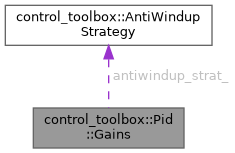
| AntiWindupStrategy | antiwindup_strat_ |
Store gains in a struct to allow easier realtime box usage.
|
inline |
Constructor for passing in values.
| p | The proportional gain. |
| i | The integral gain. |
| d | The derivative gain. |
| u_max | Upper output clamp. |
| u_min | Lower output clamp. |
| antiwindup_strat | Specifies the anti-windup strategy. Options: 'back_calculation', 'conditional_integration', or 'none'. Note that the 'back_calculation' strategy use the tracking_time_constant parameter to tune the anti-windup behavior. |
| AntiWindupStrategy control_toolbox::Pid::Gains::antiwindup_strat_ |
Anti-windup strategy.
| double control_toolbox::Pid::Gains::d_gain_ = 0.0 |
Derivative gain.
| double control_toolbox::Pid::Gains::i_gain_ = 0.0 |
Integral gain.
| double control_toolbox::Pid::Gains::p_gain_ = 0.0 |
Proportional gain.
| double control_toolbox::Pid::Gains::u_max_ = std::numeric_limits<double>::infinity() |
Maximum allowable output.
| double control_toolbox::Pid::Gains::u_min_ = -std::numeric_limits<double>::infinity() |
Minimum allowable output.
 1.15.0